I Barely Open My Editor Anymore Quase não abro mais meu editor
Across all my projects, the work quietly changed from writing code to orchestrating agents and reviewing code I didn't write. The editor slid to the edge of my day without me deciding it should. Em todos os meus projetos, o trabalho mudou discretamente: deixou de ser escrever código e passou a ser orquestrar agentes e revisar código que eu não escrevi. Sem eu decidir isso, o editor foi escorregando para a margem do meu dia.
I noticed it while fixing what should have been a small bug, reached for my editor out of muscle memory, and realized I hadn’t opened a file and typed into it directly in days. Not because I’d stopped working. I’d shipped more that week than in any week the year before. I just hadn’t written much of it. I’d described it, delegated it, watched it happen in a side panel, and approved it.
That’s when I admitted the trend to myself instead of just living inside it: the editor is drifting to the edge of my workflow, and it isn’t a decision I made on purpose. It’s the side effect of something deeper. Across all my projects, the work quietly changed from writing code to orchestrating agents and reviewing code I didn’t write, and once that happened, the editor stopped being the place I live and became a tool I visit.
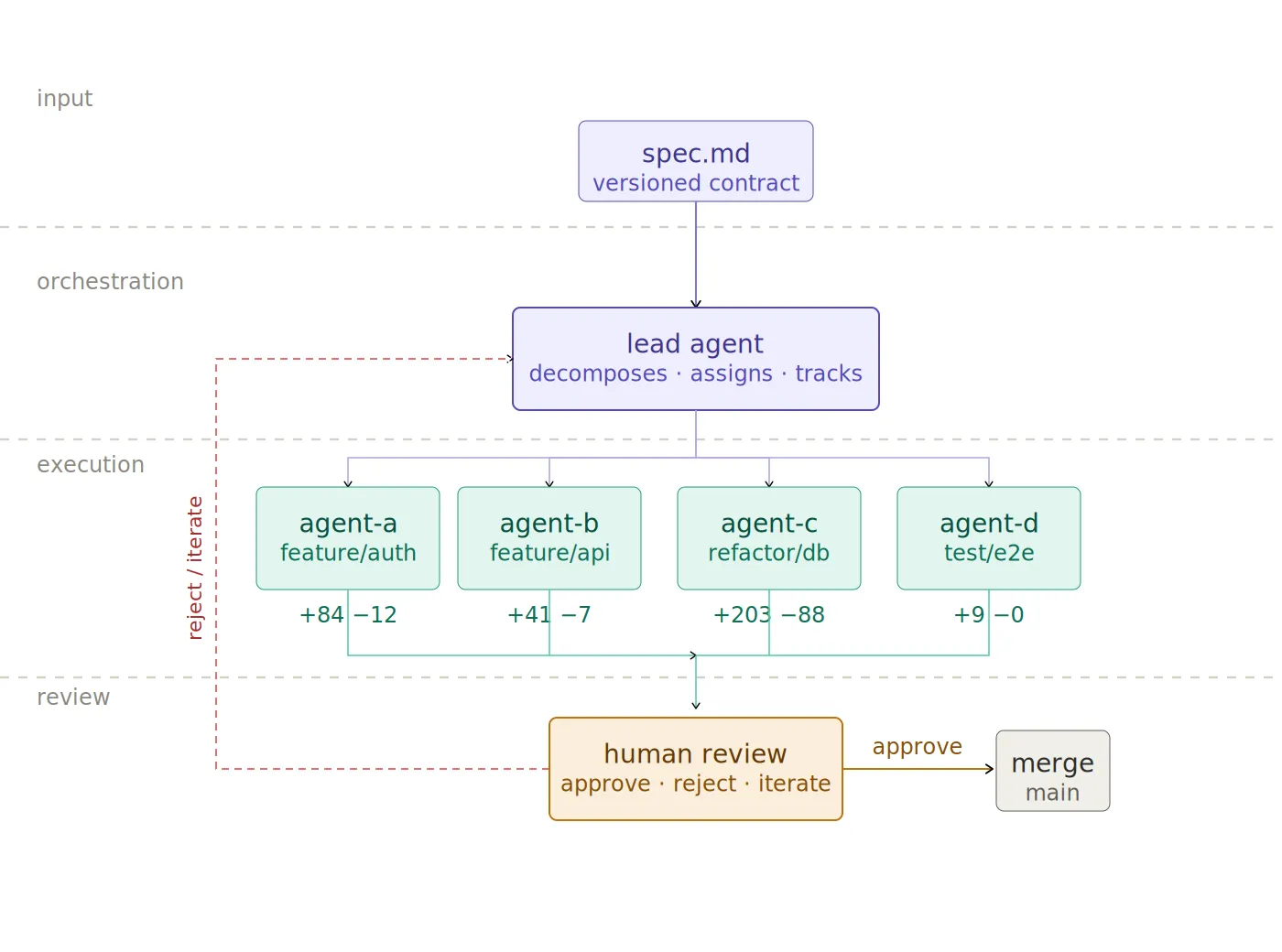
The surface kept shifting, and it stopped being the point
If you only track tools, the last few months look like a parade. Cursor shipped its third major version in April and ripped out the chat side-panel that had defined it, replacing it with an “Agents Window” built for running several agents in parallel across local and cloud environments. Claude Code grew an Agent Teams mode, a lead agent that decomposes a task and delegates to teammates, plus a research-preview “dynamic workflows” feature where it writes its own orchestration script and fans out across many subagents before anything reaches you. The framing got blunt: most code will be written by agents, and your job is to direct them.
I use these. They’re genuinely good. And after the third or fourth one I stopped caring which window the agents lived in. Terminal, dashboard, kanban board, browser tab, the surface is a detail. The pattern underneath every one of them is identical, and the pattern is the actual news: the agent is the unit of work now, not the file. This is orchestration now: I queue intent, work fans out across agents, and diffs come back for me to judge.
Now, the spec became the source of truth
The most interesting shift I’ve felt isn’t a new agent. It’s a change in where I spend my attention before the agents run.
What made agents useful for real work wasn’t finding the perfect prompt. It’s a specification: a written, versioned description of what the system should do, its constraints, and what “done” looks like, that the agent treats as a contract instead of a vibe. The top software companies now have a name for this, spec-driven development, and it’s spreading fast enough that even Andrej Karpathy, who coined “vibe coding”, has said that era is ending and we’re entering an age of orchestrating agents against detailed specs with human oversight. Every major tool has grown some version of it.
I resisted this at first. Writing a spec felt like the bureaucratic opposite of the speed the agents promised. Then I did the math on a feature I’m building: an hour spent making the spec precise saved me roughly two days of the agent confidently building the wrong thing and a near-equal stretch of me reviewing that wrong thing into existence. The spec didn’t slow me down. It moved my judgment to the front of the process, where it’s cheap, instead of the end, where it’s exhausting and expensive.
That’s the reframe that actually changed how I work: the spec is where I think, the agents are where I execute, and review is the gate, not the place I do my reasoning for the first time.
Where this actually lands
The editor isn’t going away, but its place in my day keeps shrinking, and I don’t see it moving back. It’s become the instrument I reach for in one specific situation: when an agent is almost-right and I need to hold a model of the system in my head that it can’t reconstruct. That’s a narrow, important role. It is no longer the center of how I work.
The other two extremes don’t tempt me either. Vibe coding is a great way to prototype something disposable and a terrible way to ship something you have to live with. And raw orchestration without the discipline I just described isn’t the future; that’s just a non-scalable machine with better marketing.
What changed is my role, not my tools. I used to be an author. Now I’m closer to an editor-in-chief: I direct who writes what, I set the standard it’s held to, I read everything before it ships, and I’m accountable for all of it even though I typed almost none of it. The leverage is real. The responsibility didn’t move an inch.
The takeaway isn’t that my tools got more powerful. It’s quieter and, I think, more true:
The machine got faster at producing. I’m still the slow, expensive, and i hope so 😅, irreplaceable part. The whole game now is deciding where to spend that.
Percebi isso enquanto corrigia o que deveria ser um bug pequeno. Abri o editor no piloto automático e me dei conta de que fazia dias que eu não abria um arquivo para digitar nele diretamente. Não porque eu tivesse parado de trabalhar. Naquela semana, eu tinha entregado mais do que em qualquer semana do ano anterior. Eu só não tinha escrito grande parte daquilo. Eu tinha descrito, delegado, acompanhado acontecer em um painel lateral e aprovado.
Foi aí que admiti a tendência para mim mesmo, em vez de apenas continuar vivendo dentro dela: o editor está indo para a borda do meu fluxo de trabalho, e isso não foi uma decisão consciente. É o efeito colateral de algo mais profundo. Em todos os meus projetos, o trabalho mudou discretamente: deixou de ser escrever código e passou a ser orquestrar agentes e revisar código que eu não escrevi. Quando isso aconteceu, o editor deixou de ser o lugar onde eu moro e virou uma ferramenta que eu visito.
A superfície continuou mudando, até deixar de ser o ponto
Se você olha apenas para as ferramentas, os últimos meses parecem um desfile. O Cursor lançou sua terceira versão principal em abril e removeu o painel lateral de chat que o definia, substituindo-o por uma “Agents Window” feita para rodar vários agentes em paralelo, em ambientes locais e na nuvem. O Claude Code ganhou um modo Agent Teams, com um agente líder que decompõe uma tarefa e delega para colegas, além de um recurso em prévia de pesquisa chamado “dynamic workflows”, no qual ele escreve o próprio script de orquestração e se espalha por vários subagentes antes que qualquer coisa chegue até você. O enquadramento ficou direto: a maior parte do código será escrita por agentes, e o seu trabalho é direcioná-los.
Eu uso essas ferramentas. Elas são realmente boas. E, depois da terceira ou quarta, parei de me importar com a janela em que os agentes moravam. Terminal, dashboard, quadro kanban, aba do navegador: a superfície é detalhe. O padrão por baixo de todas elas é idêntico, e esse padrão é a notícia de verdade: o agente agora é a unidade de trabalho, não o arquivo. Orquestração, agora, é isso: eu enfileiro uma intenção, o trabalho se distribui entre agentes, e os diffs voltam para eu julgar.
Agora, a especificação virou a fonte da verdade
A mudança mais interessante que senti não foi um novo agente. Foi uma mudança em onde eu coloco minha atenção antes de os agentes rodarem.
O que tornou agentes úteis para trabalho de verdade não foi encontrar o prompt perfeito. Foi a especificação: uma descrição escrita e versionada do que o sistema deve fazer, quais são suas restrições e como se parece o “pronto”, que o agente trata como contrato em vez de vibe. As principais empresas de software agora têm um nome para isso, spec-driven development, e a prática está se espalhando rápido o bastante para que até Andrej Karpathy, que cunhou “vibe coding”, tenha dito que essa era está acabando e que estamos entrando em uma fase de orquestrar agentes a partir de especificações detalhadas, com supervisão humana. Toda ferramenta importante ganhou alguma versão disso.
No começo, eu resisti. Escrever uma especificação parecia o oposto burocrático da velocidade que os agentes prometiam. Depois fiz as contas em uma funcionalidade que estou construindo: uma hora deixando a especificação precisa me poupou cerca de dois dias de um agente construindo com confiança a coisa errada, além de quase o mesmo tempo comigo revisando essa coisa errada até ela parecer aceitável. A especificação não me deixou mais lento. Ela deslocou meu julgamento para o começo do processo, onde ele é barato, em vez de deixá-lo para o fim, onde é cansativo e caro.
Esse foi o reenquadramento que de fato mudou meu jeito de trabalhar: a especificação é onde eu penso, os agentes são onde eu executo, e a revisão é o portão de entrada, não o lugar onde eu raciocino pela primeira vez.
Onde isso realmente para
O editor não vai desaparecer, mas o espaço dele no meu dia continua diminuindo, e eu não vejo isso voltando atrás. Ele virou o instrumento que eu busco em uma situação específica: quando um agente chega quase lá e eu preciso manter na cabeça um modelo do sistema que ele não consegue reconstruir. É um papel estreito e importante. Mas já não é mais o centro de como eu trabalho.
Os outros dois extremos também não me atraem. Vibe coding é uma ótima forma de prototipar algo descartável e uma péssima forma de entregar algo com que você vai ter que conviver. E orquestração pura, sem a disciplina que acabei de descrever, não é o futuro; é só uma máquina que não escala com um marketing melhor.
O que mudou foi o meu papel, não as minhas ferramentas. Eu costumava ser autor. Agora estou mais perto de um editor-chefe: eu direciono quem escreve o quê, defino o padrão que precisa ser atingido, leio tudo antes de ir para produção e sou responsável por tudo, mesmo tendo digitado quase nada daquilo. A alavancagem é real. A responsabilidade não saiu do lugar.
A conclusão não é que minhas ferramentas ficaram mais poderosas. É algo mais silencioso e, acho, mais verdadeiro:
A máquina ficou mais rápida em produzir. Eu continuo sendo a parte lenta, cara, e espero que continue sendo 😅, insubstituível. O jogo inteiro, agora, é decidir onde gastar isso.
- #ai
- #agents
- #workflow
- #personal